
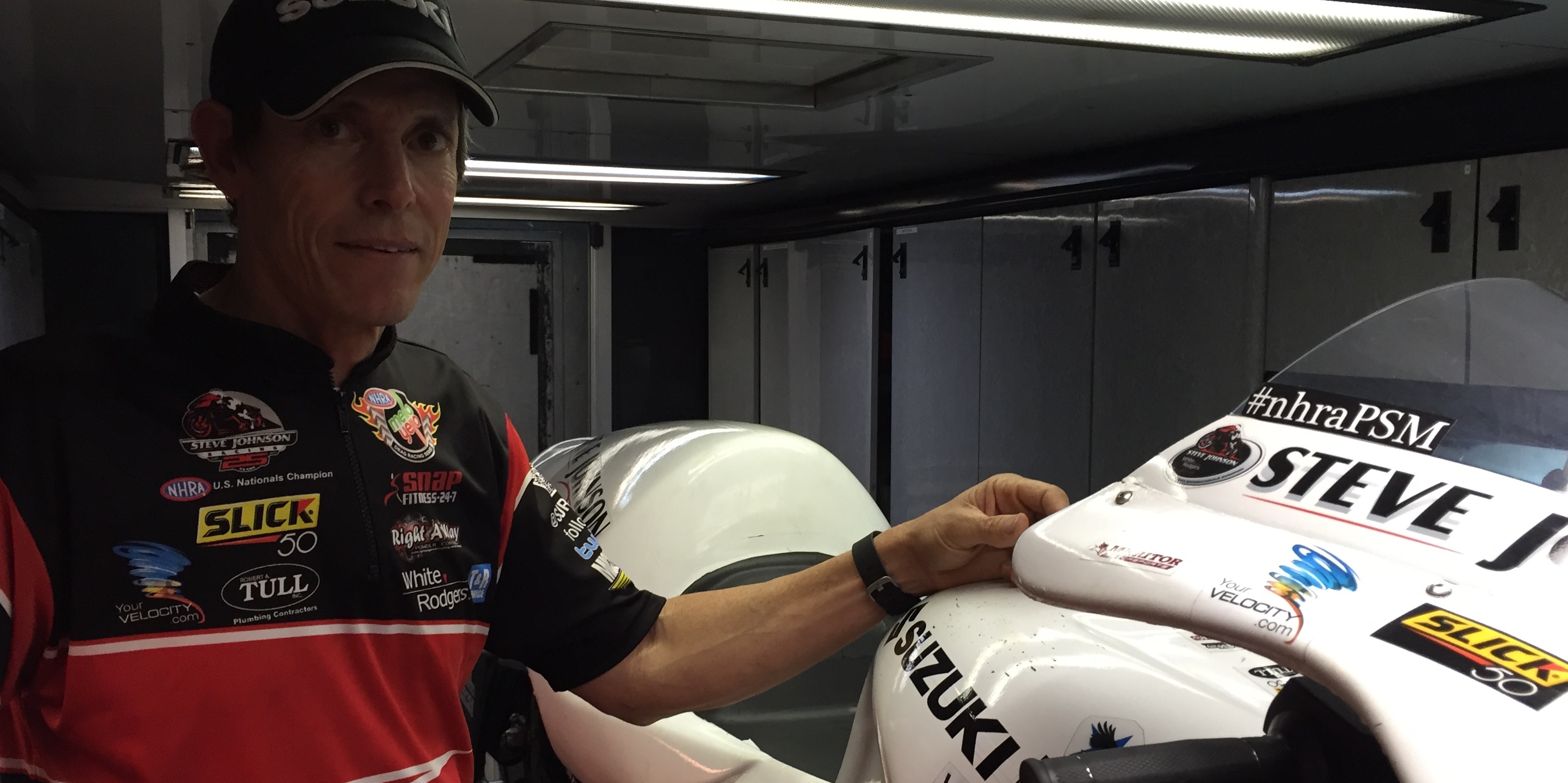
In racing there is a saying – speed costs money.
You don’t have to remind Pro Stock Motorcycle racer Steve Johnson.
Perhaps no other competitor is savvier when it comes to the ins and outs of dragbike racing than veteran Johnson, 50, of Irondale, Ala. After 24 years of racing Johnson can not only cut a light, tune a clutch, and assemble a team with the best of them, he also has gained an immense knowledge of the business behind the sport.
The economics of the class have become increasingly important and changed a great deal from Johnson’s NHRA debut in 1987, when he would drive his 17-foot box van to the hotel every night and hope his motorcycle didn’t get stolen. Now lavish 18-wheel rigs and state-of-the-art tools have become commonplace. Expenses have risen considerably and securing necessary funding has become a science.
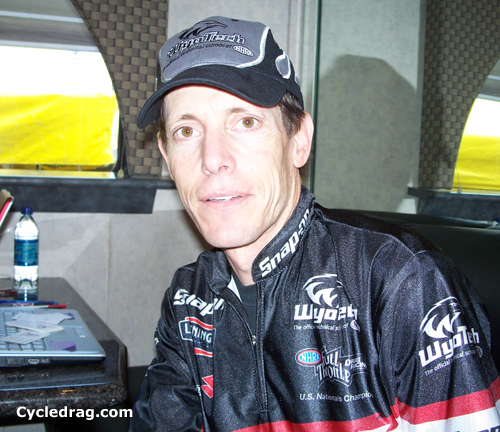
“It’s a fine-tuned business model. Paying your bills and getting sponsorship are everything,” Johnson said. “How much funding you have directly affects how you tune your motorcycle.”
In the late 80s, Johnson’s business strategy was simple – make a run, then head up to the Winston suite to schmooze potential sponsors. Now Johnson spends more time than he ever imagined educating companies on the worth of his sport.
“We provide a value for corporate America to convey messages, and with ESPN 2 as a partner, we can do it in an entertainment venue,” Johnson said. “Every ticket is a pit pass. You come right into our locker room. Where else can you do that? Plus, it takes between 2-4 million to run a Top Fuel team and only $700,000 to run a Pro Stock Motorcycle team.”
Johnson believes the responsibility to improve the financial landscape of the Pro Stock Motorcycle category lies squarely on the shoulders of all the racers themselves.
“If you don’t realize at the end of the day, you get what you negotiate for, you have your blinders on. No one is going to come over and hand our race team a million dollars. NHRA isn’t going to come over and say what can we do for you guys,” Johnson said.
The experienced racer dealt with plenty of financial issues when he represented PSM for over ten years in an organization called PRO2. Before stepping down in the beginning of 2008, Johnson made plenty of progress during his tenure. He even fought to change the name of the class from Pro Stock Bike to Pro Stock Motorcycle, citing that professional riders don’t race $100,000 “bikes.”
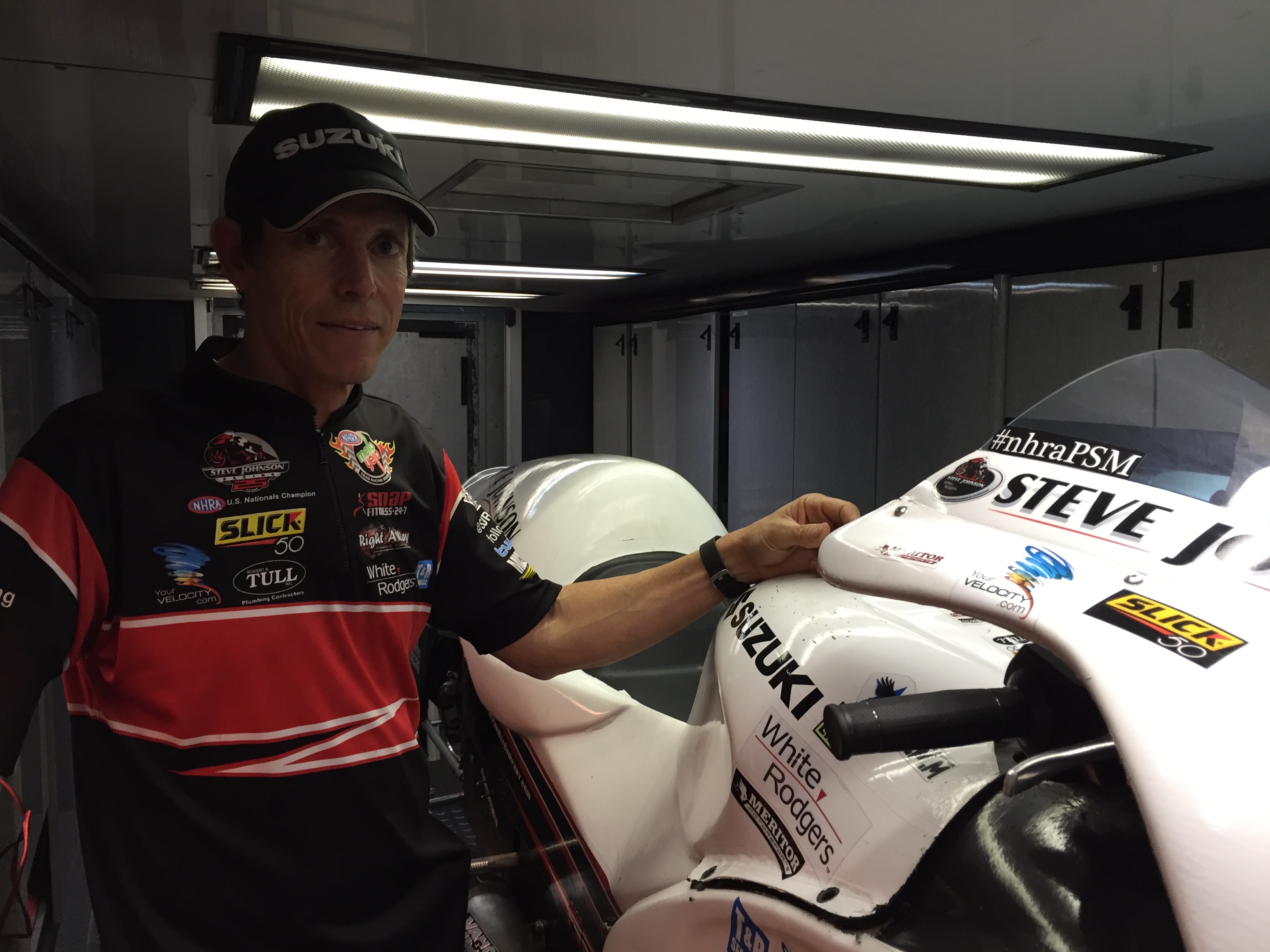
Unfortunately the class is struggling to find someone new to step-up in PRO2, which concerns Johnson.
“We need someone to represent the mouths that can’t speak,” Johnson said. “It’s hard to find someone to do the job for no pay and the guys in the trenches can’t do it because they are too busy working on winning races.”
Given the current economic climate, Johnson believes PRO2 is needed more now than ever.
“What’s scary is we only had 16 motorcycles at an event this year for the first time since 1996,” Johnson said. “When that occurred in 96, a bunch of racers said we need to do something internally, and that’s how PRO2 was created.”
Along with racer turnout becoming alarmingly low, major sponsorship deals have become scarce. For many teams, getting through a season financially has become more of an exertion than turning the win light on.
“There’s nothing more important than paying the bills. We need to survive, that’s what companies try to do,” Johnson said. “We’d like to win every event, but if we can keep racing and stay in the top ten, it’s a great accomplishment.”
Additionally, the class has become inundated with controversy over rules. Like most Suzuki riders, Johnson believes rule changes should be implemented to even the playing field between the Suzukis, Harleys, and Buells. He also asserts economic issues are far more imperative moving forward.
“The class needs some work,” Johnson said. “I have a Suzuki so sure I’d love them to weigh ten pounds and have small block Chevys in them. But in reality there are so many more important things going on with our class regarding sponsors, parking, TV time, tickets, hospitality and a million other things that make racing profitable.”
In the meantime, Johnson, who has five wins in 14 career final rounds, is doing everything in his power to keep his own team going. One of Johnson’s biggest scores was landing a partnership with WyoTech, a leading mechanical institute.
Johnson has benefited greatly from the deal but also feels the catch 22 which exists for a small race team. Sponsor commitments take away valuable time Johnson once used to improve his own outfit.
Several times a year WyoTech students enter Johnson’s shop for an in-depth look at his racing operations.
“We try to give them an experience they will never forget,” Johnson said.
The students are taught lessons in data retrieval, shown the latest tools from Snap-On, entered in a practice tree reaction time tournament and even offered tips on how to get jobs. Johnson loves the experience except for one small detail.
“It sure doesn’t make your motorcycle go quicker,” Johnson said. “That’s a full time job in itself.”
So far Johnson’s motorcycle has been as quick as 6.955 and as fast as 194.07. Like any other competitor, he’s always looking for improvement, especially with others in the class dipping into the 6.80s, like record-holder Hector Arana, who holds the mark at 6.851.
Although he performs his own maintenance to minimize expenses, Johnson buys his motors from class juggernaut Vance and Hines because he believes they will always be the pinnacle of the sport. On the other hand, he worries having the ever-powerful engine builder compete alongside its customers could be destructive to the category.
“If Vance and Hines ever decide they are going to win at all costs, we’d be buried,” Johnson said. “They have resources, tons of knowledge and equity in the sport. On paper they should win every time. It’s humbling. If you beat them, you know there were circumstances. I have to do a perfect job as a rider to have a chance.”
Since 2004 the Vance and Hines Screamin’ Eagle V-Rod team has won four championships, three with Andrew Hines, and one with Eddie Krawiec. In that time period, only Buell riders Matt Smith and Arana have been able to break up the V&H dominance. The last Suzuki rider to win a season title was Geno Scali in 2003.
After finishing No. 11 in the 2009 Full Throttle Series, would Johnson consider switching from Suzuki, the only brand of motorcycle he’s ever competed on?
It’s highly unlikely, but like most astute businessmen, Johnson never says never.
“If the right situation came around we’d always consider things,” Johnson said.
What really intrigues Johnson is the potential for a Pro Stock Motorcycle powered by Suzuki’s modern and ultra-powerful Hayabusa motor, as opposed to the outdated GS platform used in the class now.
“It would be expensive but nothing would be cooler than being on a Busa-bodied motorcycle with a Busa motor,” Johnson said. “A four-valve per cylinder Hayabusa versus a four-valve per cylinder 160 cubic inch Harley would be exciting.”
For now Johnson’s ultimate goal is to one day win an NHRA championship. He knows it will take a lot of hard work, luck and most importantly funding.
In the interim, Johnson will continue to preach his message to any business that will listen.
Tags: NHRA, Pro Stock Motorcycle, Steve Johnson